Cognitive Behavioral Therapy: A Practical Guide for Beginners


Cognitive Behavioral Therapy (CBT) is a practical form of psychotherapy that helps people understand how thoughts, feelings, physical responses, and behaviors influence one another. It can offer useful tools for managing emotional distress, changing unhelpful patterns, and taking small steps toward a more balanced daily life.
CBT is not about blaming yourself for difficult emotions or forcing yourself to think positively. With guidance from a licensed or qualified therapist, it provides a structured way to explore what is happening and decide what may help.
What Is Cognitive Behavioral Therapy?
Cognitive Behavioral Therapy is a structured psychotherapy that examines the relationship between thoughts, feelings, physical responses, and behaviors. By noticing these connections, you can begin to respond to challenging situations with greater flexibility and intention.
Imagine receiving a short, unexpected message from someone close to you. An automatic thought might be, “They are upset with me.” That thought may create anxiety, tension, or a racing heartbeat. You might then avoid replying, repeatedly check your phone, or ask for reassurance. The behavior can provide brief relief while keeping the worry active.
CBT explores each part of this cycle:
- Situation: What happened, and what was going on around you?
- Thoughts: What meaning did you give the event?
- Feelings and physical responses: What emotions and body sensations appeared?
- Behaviors: What did you do, avoid, or feel driven to do?
The aim is not to prove that every distressing thought is wrong. Some situations are genuinely painful, unfair, or uncertain. CBT helps you identify what is within your influence and develop coping strategies that fit your circumstances.
How CBT Works
CBT works through collaboration, clear goals, and repeated practice. You and your therapist look at current concerns, identify patterns, and test practical changes over time rather than relying only on discussion about the past.
A first step may involve describing a recent situation in detail. Your therapist might ask what you noticed, what you predicted would happen, how strongly you believed a thought, and what you did next. Together, you can choose a manageable goal, such as returning to an activity, improving sleep routines, communicating more directly, or reducing reassurance-seeking.
CBT is usually structured, but it should still be individualized. Sessions often include an agenda, review of recent experiences, teaching or practicing a skill, and planning what to try between appointments. The work may feel active because you are learning methods that can eventually be used outside the therapy room.
Progress is rarely perfectly linear. A technique that helps one person may need adjustment for another, particularly when trauma, chronic pain, neurodivergence, medical conditions, or complex life circumstances are involved. A qualified therapist should adapt the pace and approach rather than treating a worksheet as a universal solution.
For an overview of evidence-based mental health treatment information, readers can consult the National Institute of Mental Health psychotherapy resources.
Common Thinking Patterns CBT Helps Identify
CBT helps identify automatic thoughts and cognitive distortions that can intensify distress or narrow your choices. These patterns are common mental shortcuts, not proof that you are irrational or doing therapy incorrectly.
Automatic thoughts can appear quickly, often before you have time to examine them. Examples include “I will fail,” “Everyone noticed my mistake,” or “There is no point in trying.” They may feel convincing because they are familiar, especially during stress.
Cognitive distortions are recurring styles of interpretation. Common examples include:
- All-or-nothing thinking: Viewing an outcome as complete success or complete failure.
- Catastrophizing: Predicting the most threatening possible result and treating it as likely.
- Mind reading: Assuming you know what another person thinks without enough evidence.
- Overgeneralizing: Using one difficult event to make a broad conclusion about yourself or the future.
- Discounting the positive: Dismissing evidence that does not fit a negative conclusion.
These labels are prompts for curiosity, not weapons against yourself. A thought may contain some truth and still be incomplete. The useful question is often, “What information might I be overlooking, and what response would support me right now?”
Practical CBT Techniques for Beginners
Beginners can practice CBT by recording patterns, questioning interpretations, increasing meaningful activity, solving manageable problems, and taking gradual steps toward avoided situations. Start with one exercise and keep the task small enough to repeat.
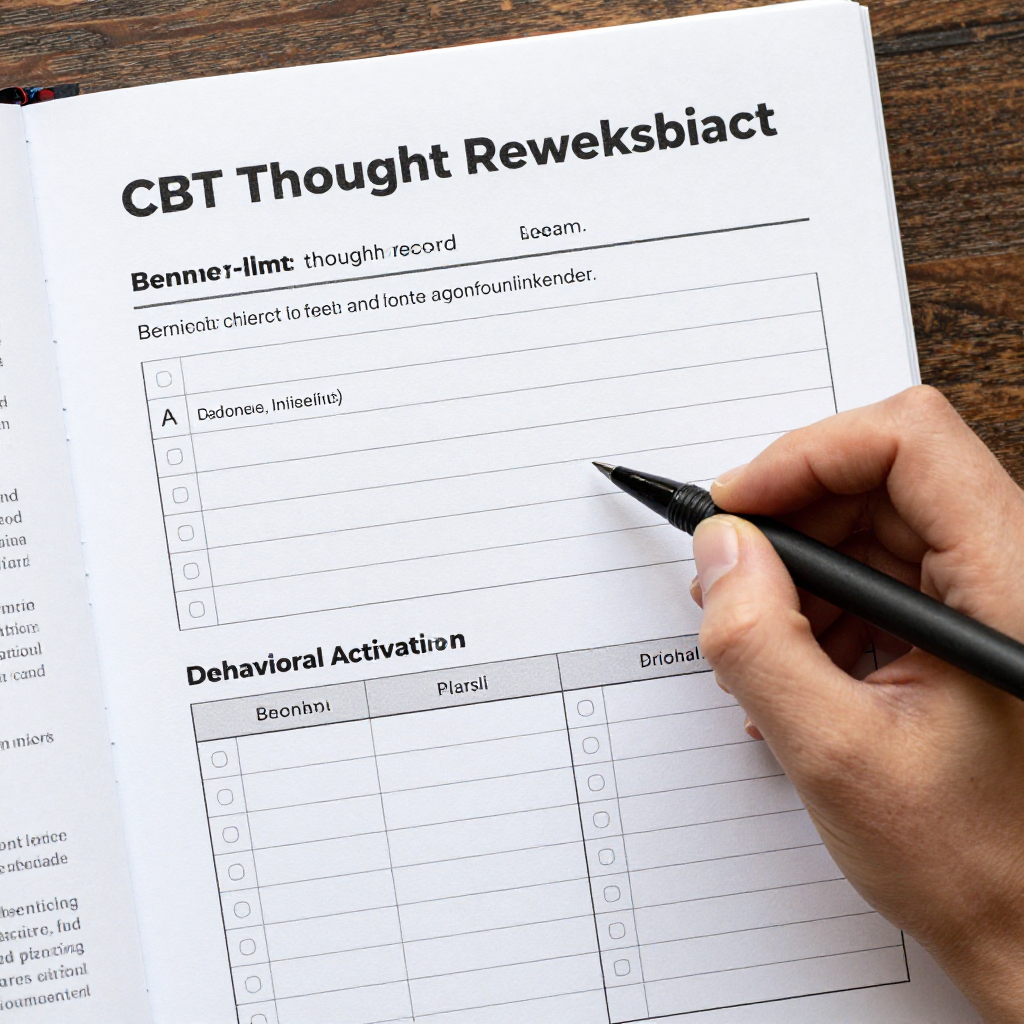
1. Use a thought record
Write down a specific situation, your automatic thought, the emotion and intensity, evidence supporting the thought, evidence that complicates it, and a more balanced perspective. For example, “I made one error in a presentation” may become “The error was uncomfortable, but I answered questions and can prepare differently next time.”
2. Question an unhelpful belief
Ask: What facts support this thought? What facts do not? Would I use the same standard with a friend? Is there another explanation? What action would be useful even if uncertainty remains? The goal is a fairer appraisal, not forced optimism.
3. Try behavioral activation
When low mood leads to withdrawal, waiting to feel motivated can keep the cycle going. Choose one modest activity connected to pleasure, mastery, health, or connection. A ten-minute walk, shower, meal preparation, or message to a trusted person may be enough for a first step. Track how you feel before and after without demanding an immediate transformation.
4. Break problems into actions
Define the problem in one sentence, brainstorm several options, choose the safest realistic step, and review what happened. This method is especially helpful when worry makes a situation feel too large to approach.
5. Approach avoidance gradually
Avoidance can reduce anxiety in the short term while strengthening fear in the long term. With appropriate support, create a gradual ladder of steps, beginning with something challenging but manageable. Do not force yourself into overwhelming exposure, particularly when trauma or safety concerns are involved.
What to Expect in a CBT Therapy Session
A CBT therapy session usually includes discussion of current concerns, goal setting, pattern review, skill practice, and a plan for between-session exercises. You do not need to arrive with the correct words or a complete understanding of CBT.
At an initial appointment, you may discuss what brought you to psychotherapy, how concerns affect work or relationships, relevant health history, and what you hope will change. The therapist may explain confidentiality and its limits, answer questions, and suggest an initial treatment plan.
Later sessions may follow a flexible structure:
- Review what happened since the previous appointment.
- Choose a current situation or goal to explore.
- Identify thoughts, feelings, physical responses, and behaviors.
- Practice a technique, such as a thought record or problem-solving exercise.
- Agree on a realistic between-session experiment.
It is reasonable to ask why a technique is being recommended, how progress will be evaluated, and what to do if an exercise feels too difficult. Therapy works best when you can offer honest feedback. You are participating in a collaborative process, not taking a test.
What Can CBT Help With—and When to Seek Support
CBT may support people experiencing anxiety, depression, panic, stress, phobias, obsessive-compulsive symptoms, sleep difficulties, and other concerns. Its usefulness depends on the person, the concern, the therapeutic relationship, and the quality of assessment and care.
CBT can be helpful when symptoms interfere with concentration, sleep, work, school, relationships, self-care, or activities you value. Professional support is also appropriate when self-help exercises increase distress, avoidance is expanding, or you are unsure what is happening.
CBT has limits. It cannot remove grief, eliminate every difficult thought, or change unsafe external circumstances by itself. Some people benefit from CBT alongside medication, medical care, trauma-informed treatment, or another therapy approach. Do not stop prescribed medication or alter existing care without speaking with the relevant healthcare professional.
If you may harm yourself or someone else, or cannot stay safe, seek urgent help through local emergency services or the nearest emergency department. Immediate safety takes priority over self-guided exercises.
Choosing CBT Support in Ontario
To choose CBT support in Ontario, look for a qualified psychotherapist whose training, registration, approach, availability, and communication style match your needs. A good fit combines professional competence with a sense that you can speak openly and work at a manageable pace.
When contacting a therapist, consider asking:
- What professional college or regulatory body are you registered with?
- What training and experience do you have with my main concern?
- How do you adapt CBT for trauma, chronic health conditions, culture, identity, or accessibility needs?
- What are your fees, cancellation policies, and expected session frequency?
- Do you offer in-person appointments in Ontario, virtual care, or both?
- How do you protect privacy during virtual sessions?
In Ontario, psychotherapy may be provided by registered professionals such as Registered Psychotherapists, psychologists, social workers, and other regulated clinicians whose scope includes the service. Verify credentials with the appropriate regulatory college, and ask whether direct billing or insurance documentation is available if that matters to you.
Virtual therapy can improve access and reduce travel, while in-person sessions may feel more grounding for some people. Neither option is automatically better. Choose the setting where you can speak privately, attend consistently, and engage with the work.
If you would like to explore whether CBT is appropriate for your situation, a consultation with a licensed or qualified therapist can help clarify your goals without requiring you to commit immediately to a long course of treatment.
Frequently Asked Questions About CBT
Is CBT suitable for beginners?
Yes. CBT is often accessible to beginners because the therapist explains the model and introduces skills step by step. You do not need prior therapy experience.
How long does CBT usually take?
The timeframe varies. Some people work on a focused goal over a limited number of sessions, while others need longer-term support for recurring, complex, or multiple concerns. Your therapist should review progress and adjust the plan with you.
Can I practice CBT techniques on my own?
Yes, you can try a thought record, behavioral activation, or structured problem-solving independently. Self-help has limits, so seek professional guidance if symptoms are severe, persistent, confusing, or worsening.
What is the difference between CBT and other types of therapy?
CBT generally emphasizes the connection between present thoughts, feelings, behaviors, and practical skill practice. Other approaches may focus more on relationships, past experiences, emotional processing, body awareness, or unconscious patterns. A therapist may integrate methods based on your needs.
When should I speak with a psychotherapist?
Consider speaking with a psychotherapist when emotional or behavioral concerns persist, limit daily functioning, or feel difficult to manage alone. You can seek support before reaching a crisis point.
CBT offers a clear starting point: notice the pattern, examine it with compassion, and choose one workable next step. If those patterns are affecting your life, professional psychotherapy in Ontario can provide individualized support, accountability, and a safer space to practice change.